UUID Generator — v1, v4, v7, ULID
Generate UUIDs — the unique 128-bit identifiers used everywhere from primary keys to distributed-system IDs. MiniMax Converter supports v1 (time + MAC, legacy), v4 (random — the default), v7 (time-ordered, sortable, modern), and ULID (Crockford-base32, sortable, URL-safe). Bulk mode for 1-10,000 at once. Multiple output formats.
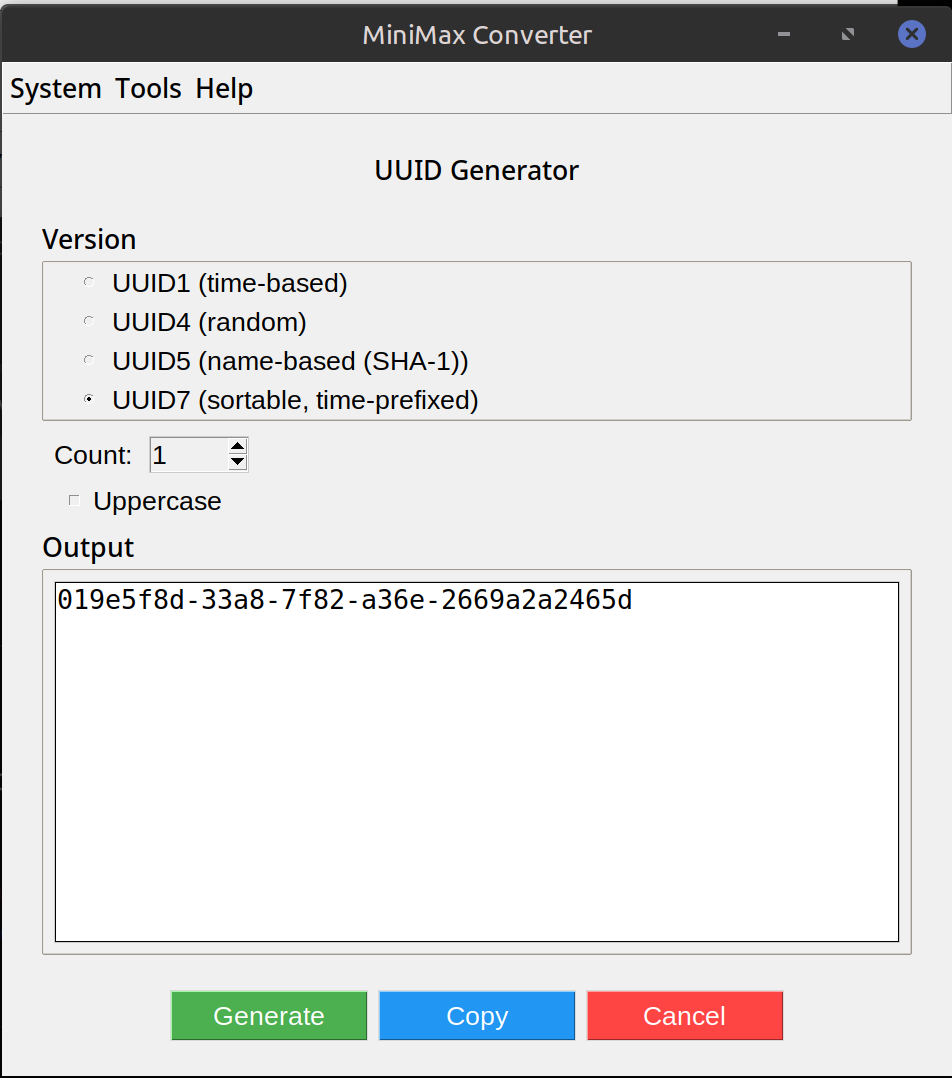
Which UUID version when
v4 (random): the default. 122 bits of entropy, effectively unique forever. Use when you don't need ordering. v7 (time-ordered): timestamp prefix + random suffix. Same uniqueness as v4 but sortable chronologically — better for database primary keys (B-tree friendly). The 2023 standard. ULID: not a UUID strictly, but similar — 26-char Crockford-base32, sortable, case-insensitive. v1 (time + MAC): legacy. Encodes timestamp + machine MAC; partly predictable. Avoid for new work.
How to use it
- Open Tools → Create & Generate → UUID generator.
- Pick version: v4 (default) / v7 / v1 / ULID.
- Enter how many to generate (1 to 10,000).
- Click Generate. The list appears — copy individual, copy all, or export as CSV.
- Format options: hyphenated (8-4-4-4-12), no hyphens (32 hex), uppercase, base64-encoded.
Why v7 is better than v4 for database keys
When you insert random v4 UUIDs into a B-tree index (the default for MySQL/Postgres primary keys), insertions land all over the index — every insert dirties multiple pages, write amplification is high. With v7, new UUIDs are time-ordered, so insertions land at the end of the tree like an auto-increment key — much more efficient. Same uniqueness, much better write performance.
Questions and answers
Are v4 UUIDs really unique?
Practically yes. With 122 bits of entropy, the probability of a collision is negligible even at planetary scale. You'd need to generate ~5 billion per second for the next 100 years to have a 50% chance of one collision.
When should I use ULID instead of UUID v7?
ULIDs are shorter (26 chars vs 36) and URL-safe by default. UUIDs are more standardised across libraries / databases. If your data layer has good UUID support, prefer UUID v7. If you're designing URLs / public IDs, ULID may be prettier.
Can I generate UUID v5 (namespace + name)?
Yes — there's a v5 mode where you provide a namespace UUID + a name string. Same name always produces the same UUID — useful for deterministic IDs.
Bulk generate millions?
The UI caps at 10,000 per generation. For more, run multiple times. Speed: 1M UUIDs takes maybe a few seconds.
Related tools
Get MiniMax Converter
Cross-platform desktop app. Linux free for non-commercial use; Windows & macOS one-time €20 license. No subscription, no telemetry, no account.