Hash Calculator — MD5, SHA-256, BLAKE2
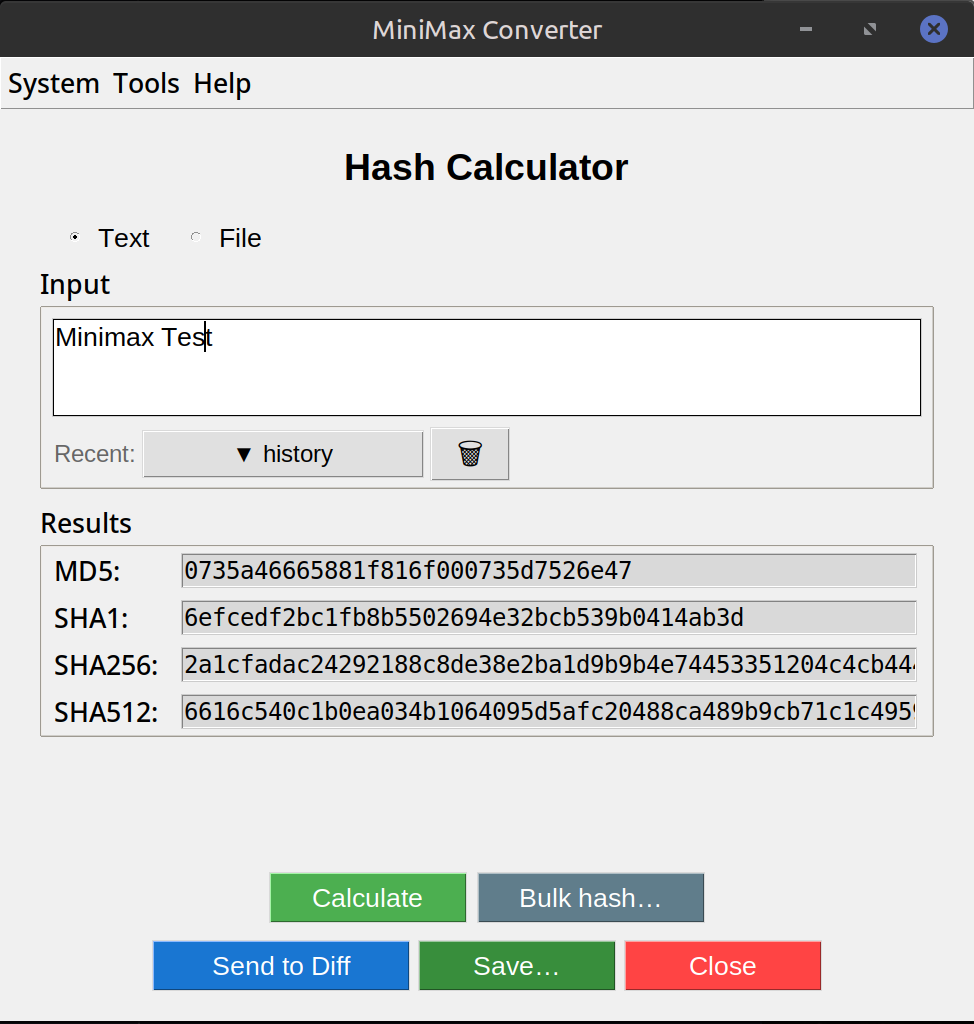
Drop any file (or paste any text) and MiniMax Converter computes its hash in every common algorithm at once: MD5, SHA-1, SHA-256, SHA-384, SHA-512, SHA3-256, SHA3-512, BLAKE2b, BLAKE2s. Use it to verify a downloaded file against a published hash, generate fingerprints for backups, or compare two files' contents without opening them. Offline — no upload, no API rate limit, works on any file size.
Why hashes matter
A cryptographic hash is a fixed-length fingerprint of any input. The smallest change in the input flips roughly half the hash bits — so if you compute SHA-256 of a download and it matches the published hash, you can be confident the file wasn't corrupted or tampered with in transit. SHA-256 is the modern default (collision-resistant, fast, ubiquitous). MD5 and SHA-1 are broken for security but still useful for non-adversarial integrity checks.
How to use it
- Open Tools → Security & Cryptography → Hash calculator.
- For a file: drop it onto the screen. For text: paste into the text box.
- All hashes compute in parallel — typically under a second even for multi-gigabyte files (limited by disk read, not CPU).
- Paste a known-good hash into the Verify box to check — green if matched, red if not.
Which algorithm when
SHA-256 for everything new. Universal default; fast on modern CPUs (SHA-NI hardware acceleration helps). SHA-1 / MD5 only for non-security uses (legacy file deduplication, comparing two non-adversarial sources). BLAKE2 if you want faster than SHA-256 with equivalent security. SHA3 if you need NIST-standardized future-proofing.
Questions and answers
What's the difference between SHA-256 and SHA3-256?
Different algorithms with similar security. SHA-256 (the older SHA-2 family) is faster and more widely supported. SHA3-256 is a different mathematical construction with no known weaknesses — useful as a backup if SHA-2 ever breaks. For verification today, SHA-256.
Why does MD5 still exist if it's broken?
It's broken for collision resistance (an attacker can craft two different files with the same MD5). For non-adversarial uses — verifying that a file downloaded without corruption from a trusted source — it's still useful. Just don't use it for security-critical fingerprinting.
How fast is hashing a 10 GB file?
On a modern SSD: ~30-60 seconds total. The bottleneck is disk read, not CPU. SHA-256 with hardware acceleration runs at multi-GB/sec.
Can I hash multiple files in batch?
Yes — drop a folder and the app hashes each file and exports a CSV of paths + hashes. Useful for backup manifests.
Related tools
Get MiniMax Converter
Cross-platform desktop app. Linux free for non-commercial use; Windows & macOS one-time €20 license. No subscription, no telemetry, no account.