Unix Timestamp Converter
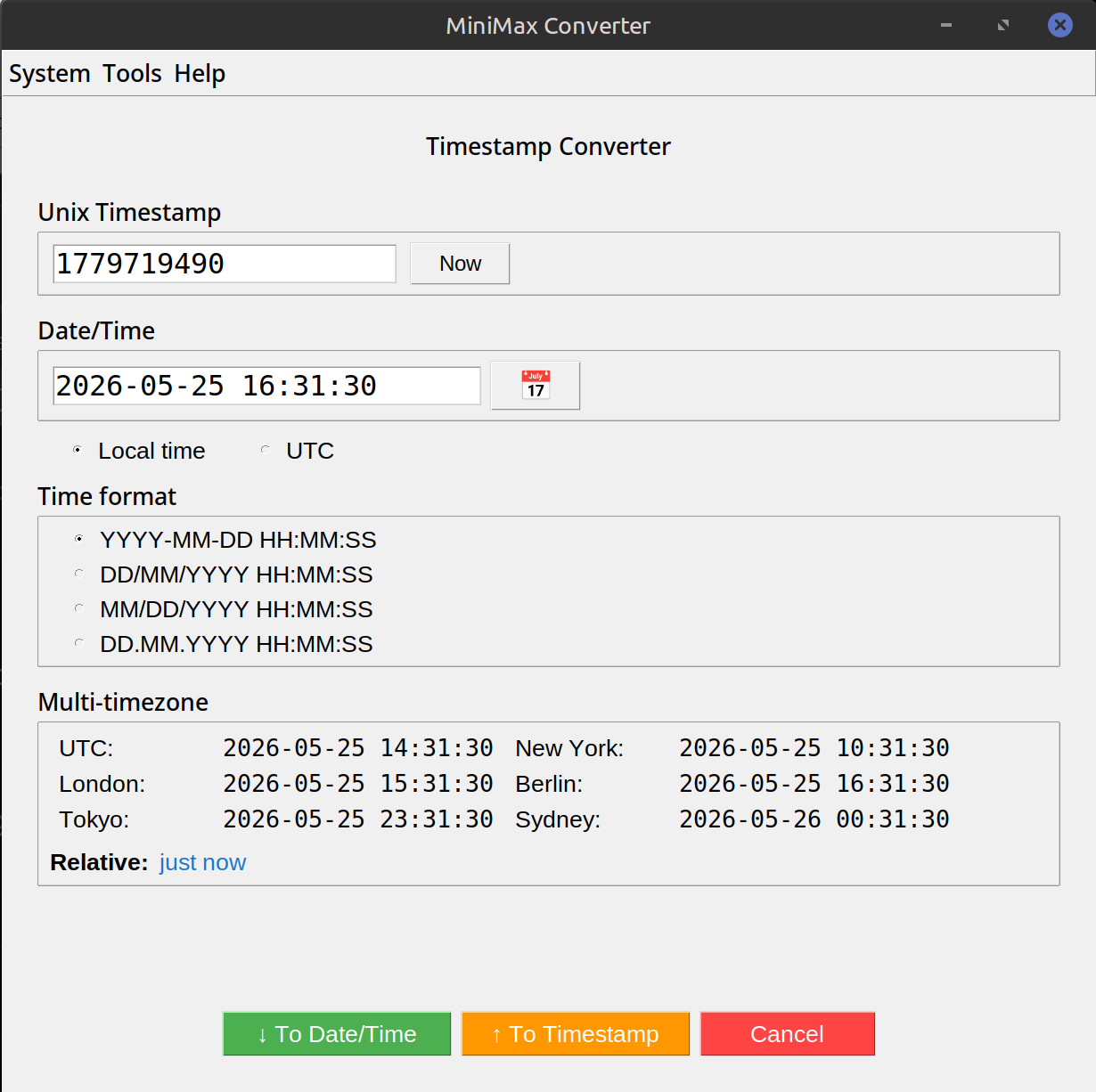
Paste a Unix timestamp (the number of seconds since 1 Jan 1970 UTC) and MiniMax Converter shows the date in your local timezone, in UTC, and in any timezone you pick. Auto-detects seconds vs milliseconds vs microseconds. Reverse direction: pick a date, get the epoch. Includes a batch mode for converting columns of timestamps from a log file.
Why epochs are everywhere
Almost every backend stores time as Unix epoch — a single integer, timezone-agnostic. JavaScript's Date.now() returns milliseconds. Postgres / MySQL UNIX_TIMESTAMP() returns seconds. Logs print epochs. Debugging usually means converting them to something human. The reverse — converting a human date to epoch — is needed to query "give me everything after 2025-01-15".
How to use it
- Open Tools → Convert & Format → Timestamp converter.
- Paste an epoch — the tool auto-detects whether it's seconds, milliseconds, microseconds, or nanoseconds (based on magnitude).
- The result shows: human-readable in your local TZ, UTC, ISO 8601 format. Pick any other timezone from the dropdown.
- Reverse: type or pick a date; the epoch in all 4 resolutions is shown.
- Click Now to insert the current timestamp.
Batch mode for log files
Paste a column of timestamps (one per line) — the tool converts each one. Useful for log analysis where you need to read what time each event happened. Export the result as CSV with both columns (epoch + human) for spreadsheet work.
Questions and answers
Seconds or milliseconds?
Seconds (~10-digit integer in 2025): used by Unix tools, Postgres, most server logs. Milliseconds (~13-digit): used by JavaScript, Java System.currentTimeMillis(), most modern logging frameworks. The tool detects automatically by magnitude.
How does it handle daylight saving time?
Timezone-aware. If you pick "America/New_York", spring-forward and fall-back are accounted for. The epoch itself is always UTC — DST only affects the human-readable display.
What about pre-1970 dates?
Negative epochs work (e.g. -1000000000 = 1938-04-24). Some systems can't handle negatives; the tool reports what the math gives.
Why does my epoch differ from Google's?
Common confusion: seconds vs milliseconds. Paste your value into the tool — it shows all four interpretations.
Related tools
Get MiniMax Converter
Cross-platform desktop app. Linux free for non-commercial use; Windows & macOS one-time €20 license. No subscription, no telemetry, no account.